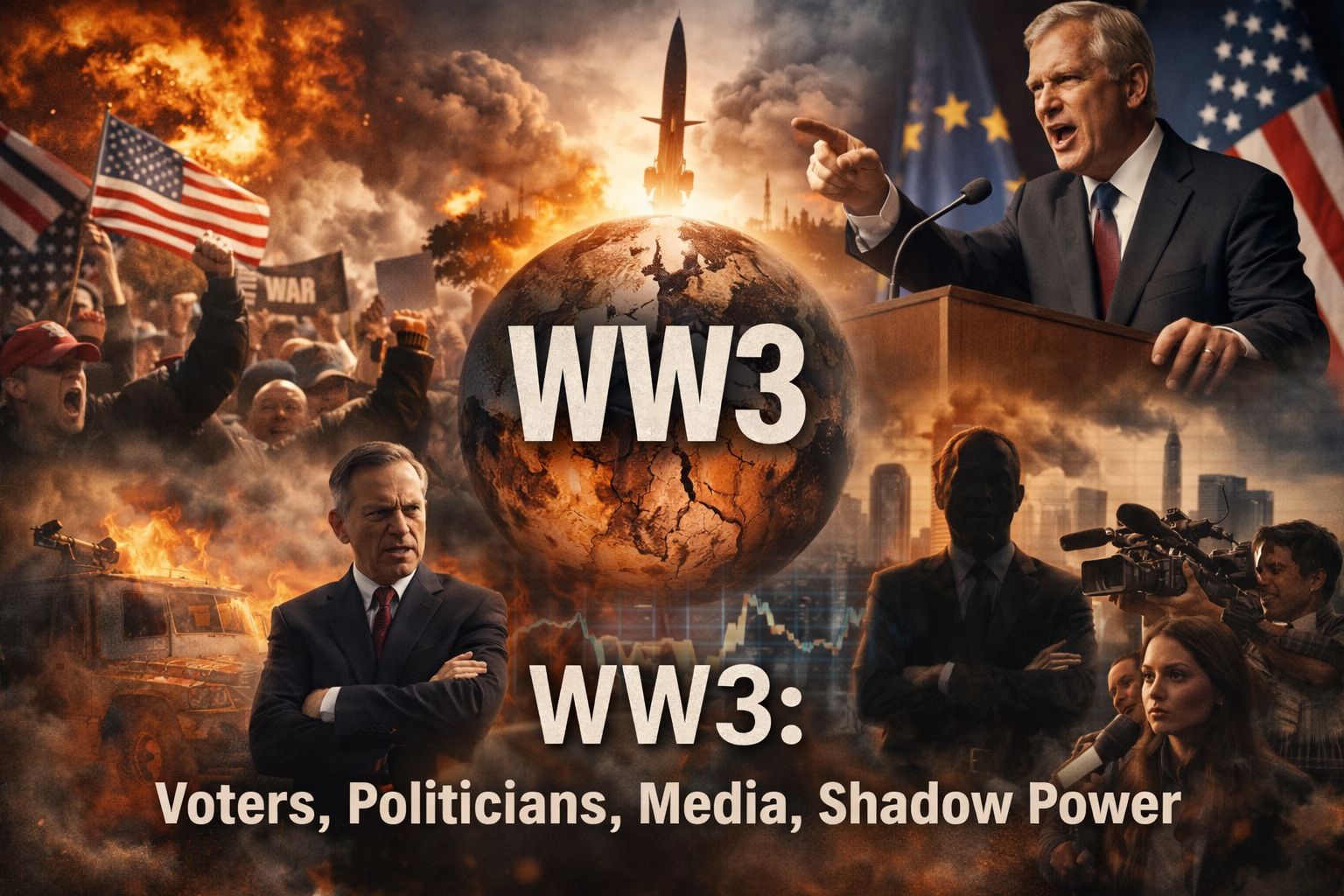
At first glance, people search for a single cause of war. Of course, it is complex, but if we should regard to simplified actors by current morality, this article is for you.
They want one villain, one mistake, one decisive moment. However, reality looks very different. Wars emerge from layers of incentives, ignorance, fear, and calculated interests. Therefore, responsibility spreads across society, but not equally.
On the one hand, voters enable. On the other hand, politicians execute. Meanwhile, shadow power structures shape long-term conditions. At the same time, journalists manufacture perception and emotional framing.
Furthermore, one must distinguish between the Global North and the Global South. They do not fight for the same reasons. They do not operate under the same constraints. Nevertheless, their conflicts overlap and reinforce each other within a single global system.
The architecture of war: Overlapping causes across the world
To begin with, wars rarely have one cause. Instead, they emerge from multiple pressures that interact and escalate over time. For example, economic inequality pushes societies toward instability. At the same time, resource competition creates tension between groups and states. In addition, historical grievances fuel long-term hostility. Moreover, ethnic and religious divisions add emotional intensity.
At a higher level, power transitions between states further increase the risk of conflict. Rising powers challenge established ones. Consequently, fear and mistrust grow. Meanwhile, institutional failures prevent peaceful resolution. In parallel, propaganda simplifies reality and mobilizes populations.
Importantly, these causes do not exist separately. Rather, they reinforce each other. A weak economy amplifies identity conflict. Political instability magnifies historical grievances. Propaganda accelerates escalation. As a result, small tensions transform into large-scale wars.
Stupid voters: Emotional tribes over rational judgment
At this point, one must examine the role of voters. Contrary to popular belief, voters do not act as rational analysts. Instead, they act as members of tribes. They prioritize identity over policy. They respond to fear, pride, and resentment.
From an evolutionary perspective, this behavior makes sense. Humans evolved in small groups. They evolved for survival, not for complex geopolitical systems. Therefore, modern political environments overwhelm their cognitive limits.
As a consequence, voters reward aggression. They interpret compromise as weakness. They demand strength even when it leads to escalation. In turn, politicians respond to these incentives. They mirror the emotions of the electorate, they simplify narratives. They create enemies. Thus, voters become a direct force behind conflict.
Stupid politicians: Incentives to escalate, not to solve
However, voters alone do not create wars. Politicians operate within a system that rewards escalation. In fact, their incentives often push them away from peace.
First, war increases visibility. Second, war unifies the population. Third, war distracts from domestic failure. Therefore, leaders frequently externalize internal problems. Economic stagnation becomes a foreign threat. Social division becomes national defense. Political survival becomes the primary objective.
Meanwhile, peace offers fewer immediate benefits. It requires compromise. It exposes weakness. And it demands long-term thinking. Consequently, politicians often choose controlled conflict over stable peace.
Stupid shadow eminences: Money, power, and strategic instability
Beyond visible politics, deeper structures operate. Financial interests, strategic elites, and institutional networks shape long-term conditions. Although they rarely appear in public discourse, their influence remains decisive.
In particular, wars create markets. They generate demand for weapons, reconstruction, and financial services. At the same time, they reshape global hierarchies. They protect dominance or enable its transition.
In the Global North, this dynamic often manifests as capital control and strategic influence. By contrast, in the Global South, it appears as dependency and resource extraction. Therefore, these systems do not require direct control. Instead, they operate through incentives and constraints.
Stupid journalists: Manufacturing consent and outrage
At the same time, media plays a crucial role. It does not simply report reality. Instead, it constructs it. Complex conflicts become simple moral stories. Nuance disappears. Emotional framing dominates.
Moreover, journalists select narratives that attract attention. They amplify fear. They personalize conflict, they reduce structural causes to individual villains.
As a result, public perception detaches from reality. Citizens support policies they do not fully understand. They react to images and slogans instead of systems. Consequently, media becomes an active participant in the escalation process.
Global North: Wars of power, control, and systems
Turning now to structural differences, the Global North operates from a position of strength. It has wealth, stable institutions, and global influence. Therefore, its wars rarely focus on survival. Instead, they focus on dominance.
Geopolitical competition drives conflict. Power transitions between major states create tension. In addition, economic systems require access to markets, energy, and supply chains.
Furthermore, these wars often remain indirect. They take the form of proxy conflicts, sanctions, and economic warfare. Thus, the objective is not immediate destruction, but long-term control.
Global South: Wars of survival, instability, and fragmentation
In contrast, the Global South operates under different conditions. Poverty, weak institutions, and post-colonial structures define its environment. Therefore, wars often emerge from survival pressures.
Economic hardship destabilizes governments. Ethnic fragmentation creates internal conflict. Resource scarcity intensifies competition.
As a result, these conflicts are frequently internal. They do not aim at global dominance. Instead, they arise from the struggle to maintain order and basic functioning.
The financial system: How the Global North structurally exploits the Global South
At this stage, one must address the underlying system. Modern control no longer relies on armies. Instead, it operates through finance. Debt replaces direct domination. Banks replace colonial administration.
Initially, countries in the Global South borrow to develop. However, these loans come with conditions. Austerity measures reduce public spending. Currency devaluation weakens purchasing power. Market liberalization exposes local economies to global competition.
Consequently, a cycle emerges. Countries borrow. They implement austerity. Their economies weaken. They borrow again.
At the same time, global capital flows in one direction. The Global South produces resources and labor. Meanwhile, the Global North accumulates wealth and profit.
In addition, multinational corporations extract value from low-wage regions. Profits return to financial centers. Local populations receive limited benefits.
Furthermore, local elites often cooperate with this system. They gain access to capital and political support. However, the broader population absorbs the cost.
As a result, this structure generates instability. Debt crises weaken governments. Austerity fuels unrest. Economic dependency limits sovereignty. Therefore, conflicts in the Global South often emerge from pressures embedded in the global financial system. Although these wars appear local, their roots extend globally.
Clash of banking systems: Global North vs Global South
At first glance, banking looks like a technical system. However, in reality, it represents power, control, and dependency. The Global North and the Global South do not operate under the same financial logic. Consequently, their systems collide.
In the Global North, banking systems are deep, liquid, and globally integrated. Large institutions control vast capital flows. They influence credit creation, investment direction, and monetary stability. Moreover, they connect directly to global reserve currencies and financial markets. Therefore, they shape the rules of the system itself.
By contrast, the Global South operates under constraint. Banks are smaller. Capital is limited. Financial markets are less developed. As a result, these countries depend on external financing. They borrow in foreign currencies. They rely on international institutions and external investors.
This creates asymmetry. The Global North lends. The Global South borrows. The North sets conditions. The South adapts. Consequently, financial sovereignty weakens in the South while it strengthens in the North.
Uneven risk
Furthermore, risk distributes unevenly. When crises emerge, capital flows out of the Global South and back to the North. Currencies in the South weaken. Debt burdens increase. Meanwhile, institutions in the North often stabilize through central bank support.
In addition, regulatory power differs. Northern institutions influence global standards. Southern systems must comply. Therefore, even domestic policies in the South often reflect external pressures.
At the same time, new tensions emerge. Some countries in the Global South seek alternatives. They develop regional banking systems. They attempt to bypass dominant financial networks. However, these efforts remain fragmented and limited.
Consequently, the clash is structural. It is not a direct confrontation, but a continuous imbalance. One system expands influence. The other reacts under constraint.
Ultimately, this financial divide feeds global instability. It shapes economic dependency. It amplifies inequality. And in the long run, it contributes to the very conflicts that define the modern world.
Overlap: Where North and South collide
Most importantly, one must examine the interaction between North and South. They do not operate in isolation. Instead, they form a feedback loop.
On the one hand, interventions from the Global North destabilize regions in the South. Resource extraction intensifies local tensions. Arms flows increase the capacity for violence.
On the other hand, instability in the South affects the North. Migration pressures rise. Supply chains disrupt. Regional conflicts expand.
Thus, a loop emerges. The North shapes conditions. The South reacts. The reaction creates new global tensions. Consequently, local conflicts become global risks.
Economic inequality as the hidden driver
Beneath these dynamics lies a deeper factor. Economic inequality underlies many conflicts. Poverty increases the likelihood of instability. Unequal distribution of resources fuels resentment.
Moreover, global inequality amplifies this effect. Wealth concentrates in certain regions and groups. Meanwhile, other regions remain dependent and vulnerable.
Historically, colonial legacies shaped these patterns. In the present, financial systems reinforce them. Therefore, wars often begin as economic problems. Only later do they become political and military conflicts.
The dollar: The hidden backbone of global power
At first glance, the dollar looks like a neutral global currency. However, it functions as a tool of structural power. It shapes global trade, finance, and political leverage.
To begin with, most international transactions occur in dollars. Countries buy oil, settle trade, and hold reserves in a currency they do not control. Therefore, they depend on the United States financial system.
As a result, the United States gains unique advantages. It can print money that the world demands; it can run deficits without immediate collapse. It can finance its global presence more easily than any other country.
At the same time, this system creates vulnerability for others. When countries borrow in dollars, they expose themselves to exchange rate risk. If their currency weakens, their debt becomes more expensive. Consequently, financial crises can emerge quickly.
Moreover, control over the dollar system enables sanctions. Access to global finance can be restricted. Countries can be cut off from payment systems. Thus, financial infrastructure becomes a geopolitical weapon.
In addition, capital flows reinforce inequality. Money moves toward financial centers in the Global North. Meanwhile, the Global South remains dependent on external financing. This deepens structural imbalance.
Therefore, the dollar system does not simply facilitate trade. It organizes global hierarchy. And it concentrates power. It links finance with geopolitics.
Ultimately, this creates tension. Rising powers seek alternatives. Some attempt to trade outside the dollar system. Others build parallel institutions. However, the transition remains unstable.
Consequently, the dollar stands at the center of modern conflict. Not as a visible weapon, but as a silent mechanism that shapes incentives, dependencies, and global power.
The illusion of morality in war narratives
Despite these structural causes, wars are rarely presented as conflicts of interest. Instead, they are framed as moral struggles. One side appears good. The other appears evil.
This framing simplifies reality. It hides economic motives. And it conceals strategic calculations. It mobilizes public support.
Meanwhile, media reinforces this illusion. Politicians rely on it. Voters accept it. Consequently, societies fight wars they do not fully understand.
WW3 scenario: How stupidity converges
Finally, one must consider how a global conflict could emerge. It does not require a single catastrophic decision. Instead, it emerges from convergence.
First, voters demand strength. Then, politicians escalate. Meanwhile, elites calculate risk. At the same time, media amplifies tension.
Triggers may vary. A regional conflict can expand. A resource shock can destabilize economies. A power transition can create confrontation.
In addition, modern systems increase the risk. Economies are interconnected. Alliances are complex. Therefore, a local conflict can spread rapidly across the globe.
Conclusion: War is not inevitable, but stupidity is common
In conclusion, wars are not random events. Rather, they are systemic outcomes. They emerge from incentives, structures, and human psychology.
Although the Global North and Global South differ in their immediate causes, they share underlying weaknesses. Voters react emotionally. Politicians seek power. Elites shape conditions. Media simplifies reality.
Ultimately, a global conflict will not occur because one side is purely evil. Instead, it will occur because too many actors act irrationally at the same time.
Leave a Reply