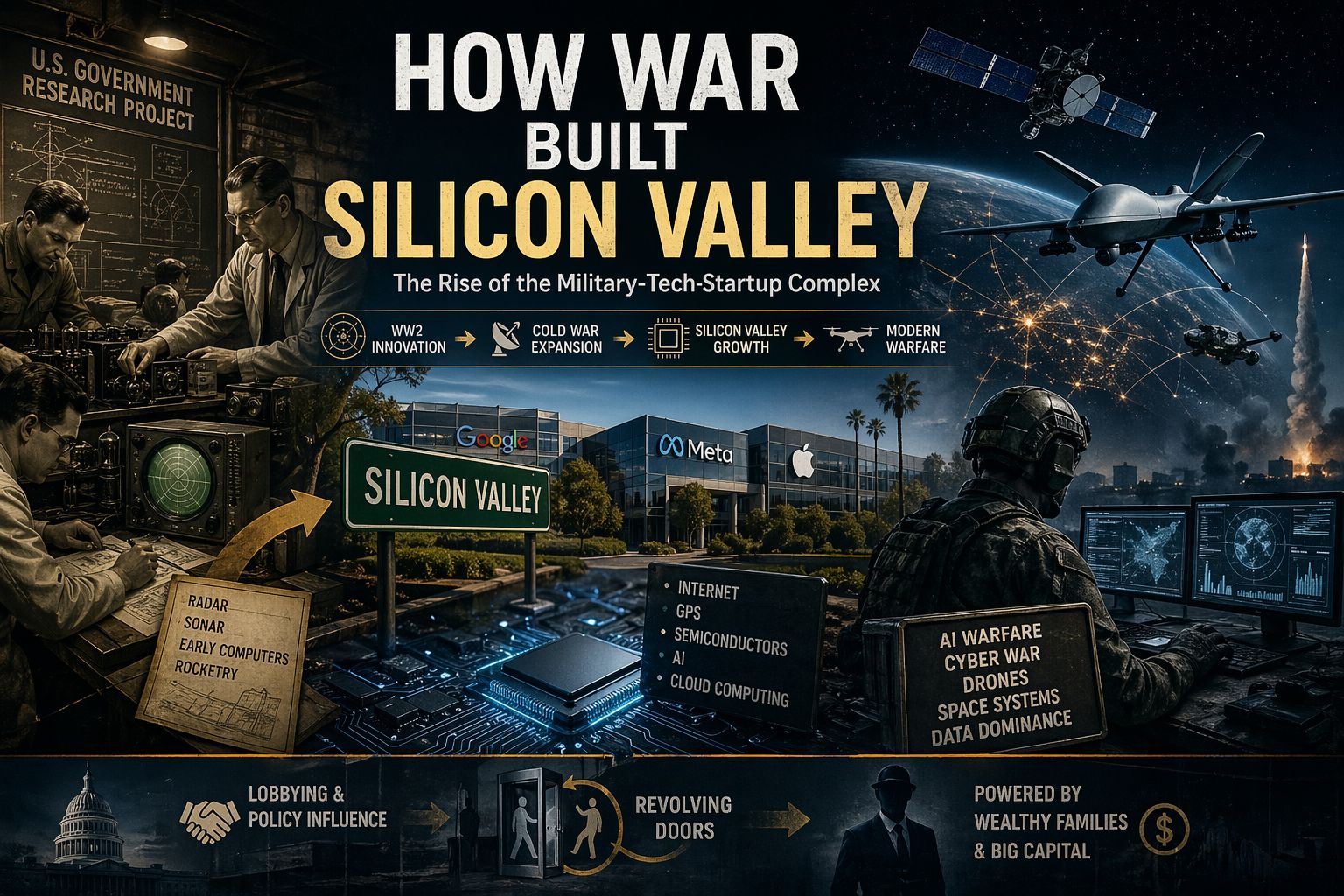
World War II reshaped not only borders but the relationship between science, industry, and power. It forced governments to mobilize knowledge at an unprecedented scale. It forced companies to innovate under pressure. It forced scientists to solve problems with immediate consequences. Therefore, the war did not only produce weapons. It produced a system.
This system linked governments, private industry, and research institutions into a single structure. It did not disappear after the war. It evolved. It expanded. Moreover, it laid the foundation for modern technological ecosystems, including startups. Consequently, to understand today’s Silicon Valley, one must begin with wartime coordination.
World War II: Birth of the military-industrial complex
During the war, governments could not operate alone. They relied on private companies for production. They relied on scientists for innovation. Radar, early computing, and advanced materials emerged from this collaboration.
At the same time, large-scale research programs created new institutional pipelines. Ideas moved from laboratories to factories. Production scaled rapidly. Therefore, innovation became organized. It became systematic.
This marked the birth of what later became known as the military-industrial complex. It was not only about weapons. It was about the integration of knowledge, capital, and state power.
Warning and institutionalization
After the war, this system did not dissolve. Instead, it stabilized. Dwight D. Eisenhower warned that the alliance between military, industry, and politics could become permanent.
His warning reflected reality. Defense budgets remained high. Research continued. Institutions adapted to peacetime while maintaining wartime connections. Therefore, what had been temporary became structural.
Moreover, this stability allowed long-term innovation ecosystems to emerge. Companies, universities, and government agencies developed lasting relationships. The system matured.
Cold War expansion: From weapons to systems
The Cold War intensified this structure. Competition between superpowers extended beyond weapons. It moved into technology, infrastructure, and information systems.
Projects such as the internet, satellite networks, and advanced computing emerged from defense needs. However, they also transformed civilian life. Therefore, the boundary between military and civilian technology blurred.
At the same time, universities, private firms, and defense agencies became deeply interconnected. Research flowed across institutions. Funding followed strategic priorities. Consequently, a complex innovation network formed.
Silicon Valley: From orchards to strategic hub
This network found a physical center in Silicon Valley. The region did not grow by accident. Defense funding, academic research, and private entrepreneurship converged there.
Universities such as Stanford linked knowledge with industry. Early technology firms received military contracts. Engineers moved between sectors. Therefore, Silicon Valley became more than an economic zone. It became a strategic node.
Its strength lies in speed. Ideas move quickly. Companies form rapidly. Capital flows efficiently. Consequently, innovation becomes continuous.
Startups: Products of the military-industrial ecosystem
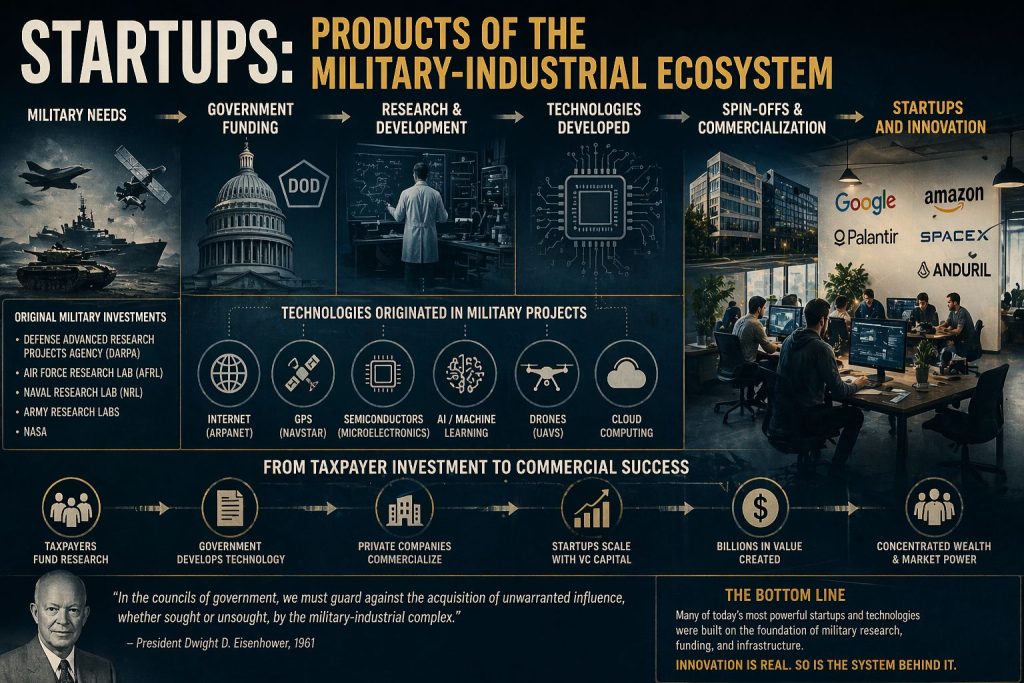
Startups often appear as independent disruptors. However, their origins tell a different story. They emerge from infrastructure built over decades. That infrastructure includes state funding, academic research, and defense-driven innovation.
Technologies such as the internet, GPS, and semiconductors originated in military contexts. Venture capital later scaled them into commercial products. Therefore, startups do not create systems from scratch. They operate within systems already built.
Moreover, founders, engineers, and investors move within these ecosystems. They rely on existing networks. They build on prior knowledge. Consequently, innovation appears decentralized, but its roots remain structured.
Postwar integration: Military, tech, and capital
After the war, cooperation expanded. Governments funded research. Companies commercialized it. Investors scaled it. Therefore, a new structure formed.
This structure links military needs with technological development and financial capital. Each component depends on the others. Governments need innovation. Companies need funding. Investors need opportunities.
As a result, boundaries weaken. Defense projects influence civilian markets. Commercial technologies serve strategic purposes. Consequently, the system becomes deeply integrated.
Post-WW2 scenario: Permanent military-tech-startup complex
This integration did not remain temporary. It stabilized after World War II and became permanent. Cooperation between military institutions, technology firms, and startups normalized.
Startups became a key layer. They translate research into applications. They move faster than large corporations. Therefore, they complement the system.
At the same time, venture capital accelerates this process. It transforms publicly funded innovation into scalable private companies. Consequently, a permanent military-tech-startup complex emerges.
States depend on private firms. Startups depend on public foundations. Investors connect both. Therefore, the system evolves from the military-industrial complex into something more flexible and pervasive.
Lobbying and revolving doors: Washington and Silicon Valley
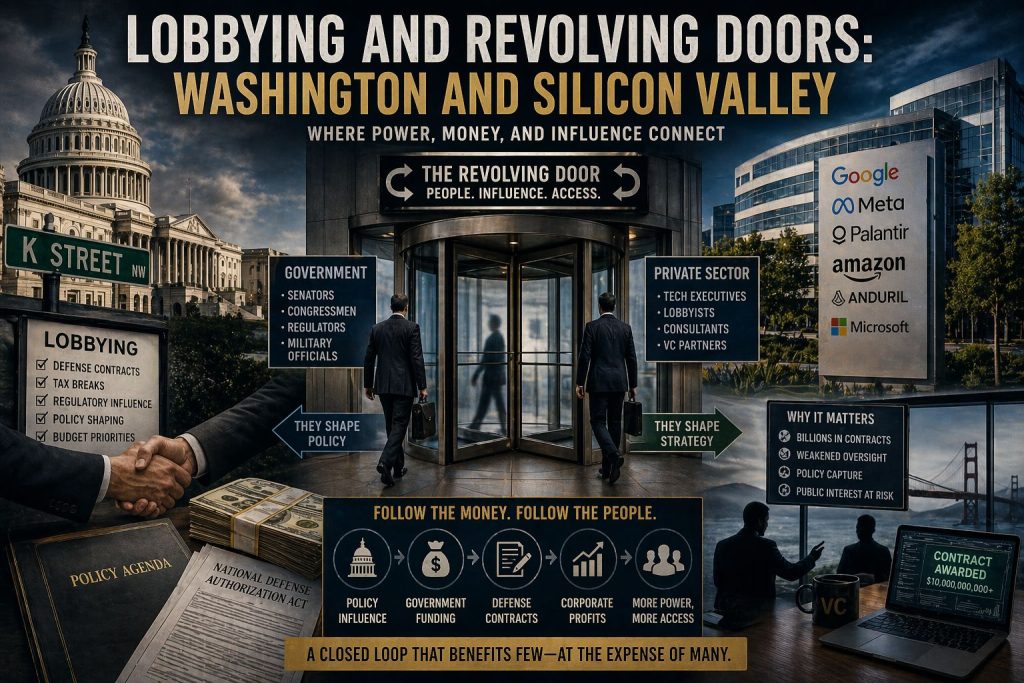
The system does not operate only through technology and capital. It operates through influence. In Washington, D.C., lobbying connects corporations, defense contractors, and policymakers. Companies advocate for contracts, regulations, and strategic priorities. Therefore, policy does not emerge in isolation. It reflects interaction between state and private actors.
At the same time, the movement of people reinforces this connection. Officials leave government and join private firms. Executives enter public office. This revolving door aligns incentives. It creates shared perspectives. Consequently, decisions often reflect system-wide interests rather than isolated viewpoints.
Wealthy families and large capital holders play a deeper role. They fund political campaigns, think tanks, and long-term strategic initiatives. Their influence does not always appear directly. However, it shapes the environment in which decisions are made. Therefore, concern about power concentration extends beyond companies and governments. It includes those who control capital behind them.
Criticism: Power, incentives, and systemic risks
The military-industrial complex generates innovation. However, it also creates structural problems. First, incentives can shift. When large budgets depend on perceived threats, there is pressure to sustain them. Therefore, conflict can become economically embedded.
Second, accountability weakens. Decisions involve multiple actors across public and private sectors. Responsibility becomes diffuse. Consequently, oversight becomes difficult.
Third, concentration increases. A small group of companies, investors, and institutions gain disproportionate influence. They shape technology, policy, and strategy. Therefore, power moves away from broader democratic control.
Fourth, dual-use technologies complicate ethics. Tools designed for civilian use can serve surveillance or warfare. AI, data systems, and communication platforms illustrate this clearly. Consequently, innovation carries unintended consequences.
Finally, dependence grows. States rely on private infrastructure. Private firms rely on government funding. This mutual dependence stabilizes the system, but it also limits alternatives. Therefore, reform becomes difficult.
World War III scenario: War driven by technology
If a global conflict emerges, this system would not need to be created. It already exists. The difference would be intensity.
A hypothetical World War III would rely on AI, cyberwarfare, drones, and space systems. Governments would depend on private infrastructure. Data would drive decisions in real time.
Moreover, startups would play a central role. Their speed and specialization would allow rapid adaptation. Consequently, the distinction between civilian and military technology would almost disappear.
Silicon Valley: The engine behind modern warfare
In such a scenario, Silicon Valley would function as a core engine. Tech companies would provide cloud computing, AI systems, and communication networks. These would become critical assets.
Engineers would become strategic contributors. Software would become infrastructure. Startups would deliver specialized solutions quickly.
Therefore, the battlefield would extend beyond physical space. It would include digital systems, information flows, and technological dominance.
Global competition: Beyond the West
This system does not exist in isolation. Other powers develop similar structures. China represents a state-driven model. India develops a hybrid approach.
Competition focuses on AI, data, and infrastructure. Each model integrates state power with technological development. Therefore, the global system becomes multipolar.
At the same time, networks remain interconnected. Technology flows across borders. Capital moves globally. Consequently, competition and interdependence coexist.
Risks: Concentration and control
This structure creates risks. Power concentrates in a small number of companies, investors, and institutions. States depend on private infrastructure. Oversight becomes difficult.
Moreover, the line between civilian and military systems blurs. Technologies designed for convenience can serve surveillance. Innovation accelerates risk.
Therefore, ethical and political questions emerge. Who controls technology? Who sets limits? Who bears responsibility?
Conclusion: From industry to technological power
World War II created the military-industrial complex. The Cold War expanded it into technological systems. Silicon Valley transformed it into a dynamic ecosystem.
Startups represent its most flexible layer. They adapt quickly. They scale rapidly. Therefore, they extend the system into new domains.
If a future conflict occurs, it will not build a new structure. It will intensify an existing one. Consequently, global power will depend not only on armies, but on control of technology, data, and innovation networks.
Leave a Reply