Capitalism has always been sold as a system of competition. The idea appears straightforward. Anyone with talent, determination, and a good idea can build a successful business. Consumers choose the best products. Inefficient companies disappear. New inventions replace old ones, while every entrepreneur has an opportunity to challenge the market leaders. Wealth, in this view, is not inherited or politically assigned. It is earned through innovation, efficiency, and risk-taking.
For much of modern history, this description reflected reality reasonably well. The Industrial Revolution produced thousands of competing businesses. Small workshops became factories. Unknown inventors transformed entire industries. Steam engines, electricity, automobiles, chemicals, aviation, and telecommunications were all developed in fiercely competitive environments. Entrepreneurs who introduced genuinely better products often became extraordinarily wealthy because they solved real problems for society.
This process also benefited consumers. Competition forced companies to improve quality while reducing prices. Every successful innovation encouraged rivals to develop something even better. Economists have long regarded this creative destruction as one of capitalism’s greatest strengths. It rewards efficiency while constantly replacing outdated technologies with superior alternatives.
Even today, this mechanism continues to exist. Artificial intelligence, biotechnology, robotics, renewable energy, and quantum computing demonstrate that innovation remains one of the most powerful forces in the global economy. New companies still emerge, and some grow into multinational corporations within only a few decades.
Yet the economy has gradually evolved in ways that classical economists could hardly have imagined. The world’s largest fortunes are no longer always created by inventing revolutionary products. Increasingly, they are maintained—and often expanded—through ownership of financial assets rather than through direct production. The question is therefore changing. Instead of asking who creates wealth, it is becoming equally important to ask who ultimately owns it.
From industrial capitalism to financial capitalism
The twentieth century witnessed one of the most profound transformations in economic history. Industrial production remained essential, but finance became increasingly dominant. Banks expanded internationally. Stock markets grew dramatically. Investment funds accumulated enormous amounts of capital. Financial institutions became deeply intertwined with virtually every major industry.
Today, manufacturing companies still produce cars, computers, pharmaceuticals, and aircraft. Technology firms continue to develop software and artificial intelligence. Pharmaceutical companies invest billions in medical research. None of this has disappeared. However, above these productive sectors stands an enormous financial infrastructure that allocates capital, purchases shares, finances acquisitions, and determines which businesses receive investment.
This shift fundamentally changed where wealth is generated.
Consider two hypothetical individuals. One spends twenty years building an engineering company, employing hundreds of people, developing new products, and competing against rivals. The other invests in diversified financial assets that steadily appreciate as global markets grow. Both may become wealthy, but the mechanisms are very different. One creates a productive enterprise. The other benefits primarily from ownership.
Modern economies require both entrepreneurs and investors. Without capital, many businesses could never expand. Yet the balance between production and finance has shifted noticeably during the past several decades. In many developed economies, financial assets have grown much faster than overall economic output. Stock market capitalization has increased enormously, while investment income has become a larger share of total wealth among the richest households.
This development has important consequences. The greater the role of financial markets, the greater the importance of owning existing assets. A person who owns valuable shares, commercial property, or investment funds may accumulate wealth even without creating new products or services. Rising asset prices alone can generate extraordinary gains.
Central banks have unintentionally contributed to this trend as well. Following major financial crises, many central banks reduced interest rates and purchased financial assets through quantitative easing. These policies helped stabilize economies and prevented deeper recessions. At the same time, they also increased the prices of stocks, bonds, and real estate. Since wealthier households own a disproportionate share of these assets, they often benefited more from rising asset values than households whose income depends primarily on wages.
This does not necessarily imply that monetary policy was misguided. Many economists argue that such interventions prevented economic collapse. Nevertheless, they illustrate an important reality of modern capitalism: financial markets increasingly influence the distribution of wealth.
Competition increasingly means oligopoly
Classical economic models often describe markets populated by many independent competitors. Each firm remains relatively small compared with the overall market. No single company can dictate prices, and new competitors can enter if they develop better products or lower costs.
Real markets frequently look very different.
In industry after industry, competition has gradually become concentrated among a surprisingly small number of corporations. Commercial aircraft are largely produced by two manufacturers. Smartphone operating systems are dominated by two ecosystems. Internet search, cloud computing, social media, payment networks, semiconductor manufacturing, pharmaceuticals, food processing, and commercial banking all display varying degrees of concentration.
This does not mean that competition has disappeared. On the contrary, competition among these large firms is often intense. Technology companies invest enormous sums in research. Pharmaceutical companies race to develop new medicines. Automobile manufacturers compete to dominate electric vehicles. Rival banks constantly seek new customers and financial products.
The difference lies in the number of competitors.
Instead of hundreds of similarly sized firms competing freely, many sectors are dominated by only a handful of global corporations. Economists describe such markets as oligopolies. These markets still function competitively, but the barriers facing new entrants are substantially higher than they were decades ago.
Building a global airline manufacturer requires decades of engineering expertise, regulatory approval, supply chains, and billions of dollars in investment. Developing a new pharmaceutical company capable of competing with established giants demands extraordinary financial resources and years of clinical testing.
Consequently, successful companies often become even stronger over time. They possess established brands, worldwide distribution networks, extensive patent portfolios, experienced legal teams, and access to financial resources unavailable to most smaller competitors. Many also acquire promising start-ups before those companies mature into genuine rivals, incorporating new technologies into their own businesses rather than allowing independent competitors to emerge.
None of this means that large corporations are inherently harmful. Their size often enables significant investment in research, logistics, and manufacturing that smaller firms simply could not afford. Consumers have benefited enormously from products developed by multinational technology firms, pharmaceutical companies, and industrial manufacturers.
Nevertheless, concentration raises legitimate questions about the future of competition. If markets become increasingly dominated by a small number of global corporations, does capitalism still function as a system in which newcomers enjoy realistic opportunities to challenge established leaders? Or does ownership itself gradually become the greatest competitive advantage?
These questions lie at the heart of modern debates about capitalism. The issue is no longer whether markets create wealth—they clearly do—but whether the structure of those markets is changing in ways that increasingly reward scale, ownership, and financial power alongside innovation itself.
Multinational corporations without borders
The modern corporation operates in a world that national governments often struggle to regulate. A company may be headquartered in one country, manufacture its products in another, employ software engineers on a different continent, own patents through subsidiaries elsewhere, and sell its products in hundreds of markets simultaneously. Capital crosses borders in seconds, while governments remain tied to fixed territories and national legal systems.
This asymmetry has become one of the defining features of globalization. States compete for investment by offering lower taxes, subsidies, favorable regulations, or simplified administrative procedures. Companies, meanwhile, can often compare jurisdictions and decide where to establish headquarters, intellectual property, or financial subsidiaries.
The result is an international marketplace in which governments compete not only for businesses but also for taxable profits.
Supporters of globalization argue that this competition benefits everyone. Countries become more efficient, bureaucracies shrink, and excessive taxation becomes more difficult. Firms can invest where they operate most efficiently, lowering costs for consumers and increasing economic growth.
Critics reach a different conclusion. They argue that multinational corporations possess bargaining power unavailable to ordinary citizens or small businesses. A local manufacturer cannot threaten to move thousands of jobs abroad overnight. A multinational corporation sometimes can. Governments therefore face pressure to maintain competitive tax systems, even when this reduces public revenue.
Neither perspective fully captures the complexity of globalization. International companies have undoubtedly contributed to unprecedented technological progress and global prosperity. They have created millions of jobs, accelerated innovation, and helped lift many developing countries into the global economy. Yet they have also acquired negotiating power that was almost unimaginable a century ago.
The question is therefore not whether multinational corporations are beneficial. Few economists would deny their enormous contribution to economic development. The real question is whether democratic governments can still regulate organizations whose operations extend across dozens or even hundreds of jurisdictions.
The world of tax havens
Whenever tax havens appear in public debate, they are often portrayed as mysterious tropical islands where billionaires secretly hide money. Reality is both more ordinary and more complicated.
A tax haven is generally a jurisdiction offering unusually favorable tax treatment, financial secrecy, or corporate structures that make it attractive for international investors and companies. Some are indeed small island nations. Others are highly developed financial centers integrated into the global economy.
It is important to distinguish between tax avoidance and tax evasion.
Tax evasion is illegal. It involves deliberately concealing income or assets from tax authorities.
Tax avoidance, by contrast, usually involves arranging financial affairs within the boundaries of existing law to reduce tax liability. Although controversial, it is generally legal unless specific anti-avoidance rules are violated.
Large multinational corporations often employ teams of accountants, lawyers, and tax specialists whose responsibility is to minimize taxation while complying with applicable laws. They may establish subsidiaries that own trademarks, patents, or other intellectual property in jurisdictions with lower tax rates. Companies operating in higher-tax countries then pay licensing fees to those subsidiaries, shifting part of their profits to jurisdictions where taxes are lower.
These arrangements can become extraordinarily complex. A single corporation may operate through hundreds of legal entities spread across multiple countries. Every structure is designed to satisfy local regulations while optimizing the firm’s overall tax position.
Supporters argue that businesses have a duty to shareholders to operate as efficiently as possible. If governments write laws allowing these structures, companies simply follow the rules that elected politicians have created.
Critics respond that legality and fairness are not always identical. They argue that profits often depend on infrastructure, educated workforces, legal systems, and public institutions financed by taxpayers. When large corporations substantially reduce their effective tax rates through international structures unavailable to smaller competitors, the burden of financing public services may increasingly fall on domestic businesses and ordinary workers.
This disagreement has led to international efforts such as the OECD’s global minimum corporate tax, designed to reduce incentives for shifting profits into extremely low-tax jurisdictions. Whether such reforms will fundamentally alter corporate taxation remains uncertain, but they illustrate how governments have begun to recognize that national tax systems alone may no longer be sufficient in a global economy.
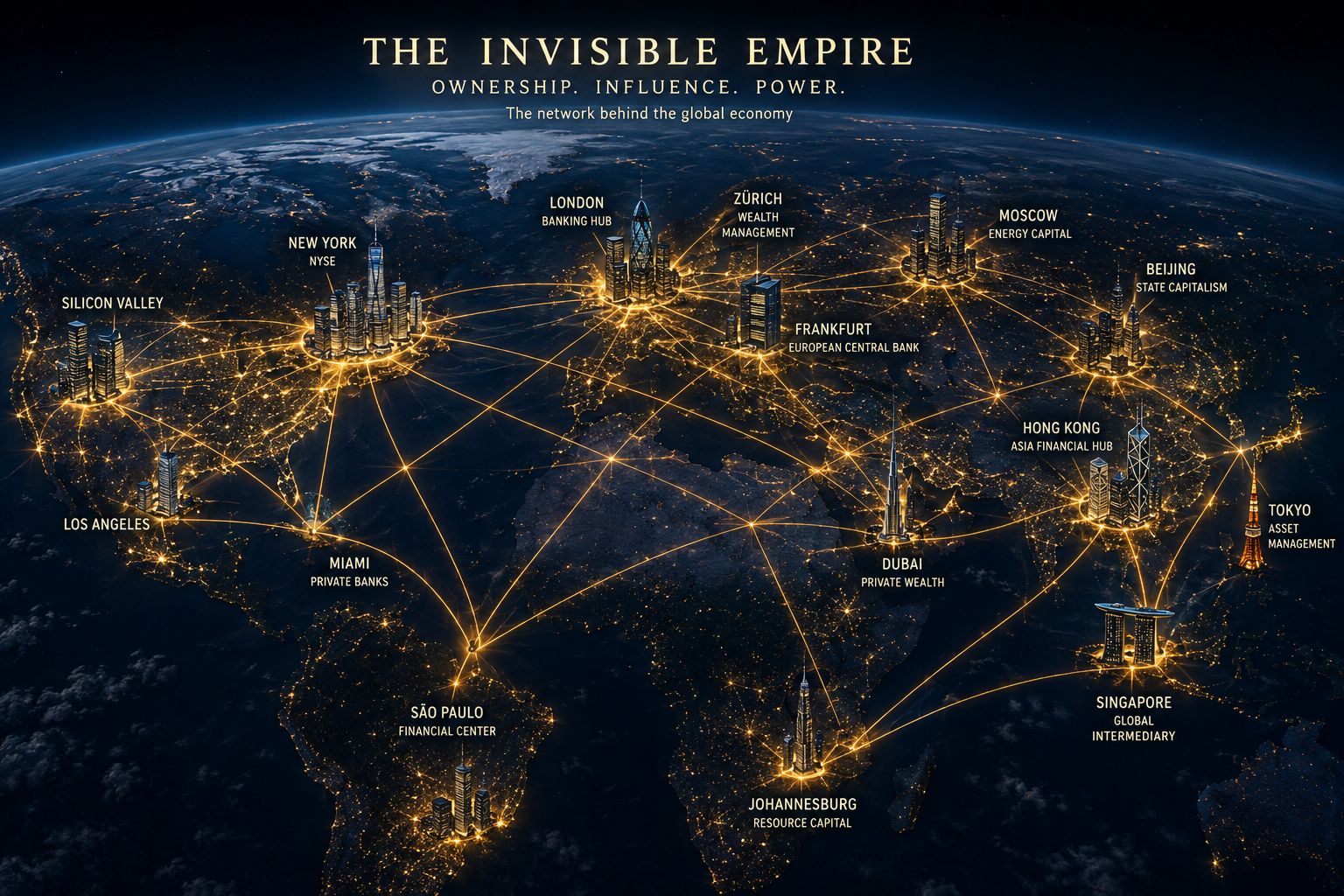
The financial web
Most people recognize the world’s largest corporations by their products. They know the technology companies whose devices they use, the banks where they keep their savings, the pharmaceutical firms that produce medicines, and the manufacturers that build cars or aircraft.
Far fewer people pay attention to who owns these companies.
Modern ownership is rarely straightforward. Shares are held by super-rich families, their banks, pension funds, insurance companies, sovereign wealth funds, mutual funds, exchange-traded funds, private equity firms, and millions of individual investors. Ownership is dispersed, yet it is also remarkably concentrated among a relatively small number of large institutional investors.
Over the past several decades, asset management has become one of the fastest-growing sectors of the global economy. Pension funds collect retirement savings from millions of workers. Mutual funds allow households to invest in diversified portfolios. Insurance companies invest premiums received from customers. Together, these institutions control trillions of dollars.
This creates an intricate financial network.
Banks lend money to corporations while simultaneously holding corporate securities. Investment funds own shares in banks, technology companies, manufacturers, retailers, and pharmaceutical firms. Pension funds invest in those same institutions on behalf of future retirees. Insurance companies purchase government bonds while also investing in private markets. Every major institution becomes connected to many others through ownership, lending, and investment.
Interdependence offers important advantages. Diversified investment spreads risk. Capital flows toward productive businesses. Companies gain access to financing that supports expansion, research, and innovation.
However, extensive interconnectedness also creates systemic vulnerabilities. The financial crisis of 2008 demonstrated how problems originating in one segment of the banking system could rapidly spread throughout the global economy. Institutions that appeared independent were, in reality, deeply connected through financial contracts, shared investments, and mutual exposure to risk.
Another issue receiving growing attention among economists is common ownership. Large institutional investors often own shares in several companies that compete within the same industry. This does not mean those investors coordinate business decisions or violate competition law. Nevertheless, some researchers have questioned whether widespread common ownership could reduce competitive incentives under certain circumstances, while others dispute the strength of the available evidence. The debate remains active and unresolved.
Modern capitalism has produced a financial system in which ownership itself has become increasingly concentrated within large institutions managing assets on behalf of millions of clients. The individuals whose retirement savings are invested through pension funds are ultimately the beneficial owners, yet the voting rights and day-to-day influence are frequently exercised by a relatively small number of professional asset managers.
This distinction matters. Economic power is no longer exercised solely by industrialists who own factories or entrepreneurs who founded companies. It is increasingly exercised through institutions that allocate capital, vote on corporate governance, influence executive compensation, and shape the strategic direction of thousands of firms simultaneously.
Understanding this financial web is essential for understanding modern capitalism. Behind the products people buy and the companies they recognize lies a vast network of ownership that has become one of the most influential structures in the global economy.
The rise of inherited wealth
One of capitalism’s most attractive promises has always been social mobility. Every generation starts anew. Those who work hard, innovate, and take risks succeed. Those who fail eventually disappear from the market. Wealth, in this idealized picture, constantly changes hands as new entrepreneurs replace old ones.
Reality is more complicated.
Many of today’s largest fortunes no longer belong to first-generation entrepreneurs. They belong to families whose wealth has survived for decades or even centuries. Industrial dynasties have become financial dynasties. Instead of managing factories directly, many wealthy families now oversee investment portfolios through private holding companies, trusts, and family offices.
A family office is essentially a private investment organization that manages the wealth of a single wealthy family. These organizations employ economists, lawyers, tax specialists, investment managers, and analysts whose sole responsibility is preserving and expanding family assets. They invest in stocks, private equity, real estate, infrastructure, venture capital, and increasingly in alternative assets such as private credit.
Their objective is not to create the next revolutionary invention.
It is to ensure that existing wealth continues generating more wealth.
This illustrates one of the most powerful characteristics of capital: it compounds. A fortune invested over several decades may grow dramatically even if no family member founds another successful company. Dividends are reinvested. Capital gains accumulate. New investments generate additional returns. Over long periods, compounding can become remarkably powerful.
Economists have debated this phenomenon for generations. Some argue that inherited wealth is simply another form of private property and should receive the same legal protection as any other asset. Parents naturally wish to provide better opportunities for their children, and inheritance has always existed in one form or another.
Others raise concerns about equality of opportunity. If wealth becomes increasingly concentrated across generations, the starting point of individuals differs enormously before talent, effort, or education even enter the equation. One young entrepreneur begins with student loans. Another begins with access to family investment funds, influential business networks, and substantial inherited assets.
Capitalism still rewards ability.
The question is whether inherited capital increasingly amplifies those rewards for some people while placing others at a permanent disadvantage.
Ownership versus innovation
Modern economies celebrate innovation.
Scientists discover new medicines.
Engineers develop new technologies.
Researchers improve batteries, semiconductors, and artificial intelligence. Entrepreneurs transform laboratory discoveries into commercial products. Society depends upon people who solve difficult problems and create something that previously did not exist.
Yet creating value and capturing value are not always the same process.
Imagine a researcher develops an important medical breakthrough while working for a pharmaceutical company. The discovery may save millions of lives and generate billions in future revenue. The scientist receives a salary, perhaps bonuses, and professional recognition. Shareholders receive a significant portion of the long-term financial returns because they own the company that commercializes the discovery.
Neither arrangement is inherently unfair.
Without investors providing capital, many discoveries would never reach the market. Clinical trials, regulatory approval, manufacturing facilities, and worldwide distribution require enormous financial resources. Investors assume genuine risks when financing these activities.
Nevertheless, ownership fundamentally determines who receives the largest share of future profits.
The same pattern appears across much of the economy. Software engineers write code, but shareholders own the company. Designers create products, but investors own the intellectual property. Factory workers manufacture goods, but shareholders own the factories. Managers build successful organizations, but ownership determines who benefits when the firm’s market value rises.
This distinction has become increasingly important as stock markets expanded. Executive compensation now frequently includes stock options. Founders often sell companies while retaining ownership stakes. Investment funds purchase shares in thousands of businesses simultaneously.
As a result, wealth increasingly flows toward those who own productive assets rather than solely toward those who operate them.
Some economists describe this as a natural feature of capitalism. Capital deserves compensation because it finances innovation, absorbs risk, and enables economic growth.
Others argue that modern financial markets may increasingly reward passive ownership relative to productive contribution. They distinguish between productive investment, which finances new factories, technologies, or businesses, and rent-seeking, where profits arise primarily from controlling scarce assets or market power rather than creating additional economic value.
The distinction remains controversial. Determining where productive investment ends and rent-seeking begins is often difficult. Yet the debate reflects a broader concern that ownership itself may have become one of the most valuable economic assets.
Does society reward the greatest contribution?
Economic success and social contribution are not necessarily identical concepts.
A physician may save hundreds of lives during a career.
A scientist may develop a vaccine that protects millions of people.
An engineer may design safer bridges, cleaner energy systems, or more efficient transportation networks. Teachers educate future generations. Researchers expand human knowledge. Software developers create tools used by billions of people.
All of these professions contribute directly to society’s productive capacity.
At the same time, modern financial markets can generate extraordinary wealth for individuals whose primary role is allocating capital rather than producing goods or services themselves. Successful investors perform an important economic function by directing resources toward promising businesses. Banks provide credit that allows firms to expand. Asset managers help finance retirement systems serving millions of people.
The question is therefore not whether finance contributes to society.
It clearly does.
The more difficult question concerns proportionality. Should compensation primarily reflect market demand, regardless of occupation? Or should societies consider broader measures of social value when designing tax systems and public policy?
Markets answer one question extremely well: what people are currently willing to pay.
They do not necessarily answer another question: what activities create the greatest long-term benefit for society.
A professional athlete may earn far more than a Nobel Prize-winning scientist. A successful investor may accumulate more wealth than thousands of teachers combined. This outcome reflects supply, demand, risk, and market preferences rather than any objective measurement of social importance.
Some economists argue that this is precisely how markets should function. Governments should not attempt to determine whose work is more valuable because prices emerge from millions of voluntary transactions.
Others disagree. They argue that markets sometimes undervalue activities with enormous public benefits, such as education, scientific research, or preventive healthcare, while placing exceptionally high financial value on scarce ownership rights or financial assets.
These competing perspectives explain why debates over taxation remain so contentious.
Supporters of higher taxes on wealth often argue that those benefiting most from financial systems and accumulated capital should contribute proportionately more to maintaining the institutions that make those systems possible. Defenders of lower taxation respond that successful investors already finance innovation, create employment through investment, and bear substantial financial risks.
Neither side possesses a universally accepted answer.
What is increasingly clear, however, is that modern capitalism has become far more complex than the simple image of entrepreneurs competing in open markets. Innovation remains essential. Hard work continues to matter. Entrepreneurship still changes the world.
Yet ownership, financial markets, inherited capital, and global investment networks now play an equally central role in determining who ultimately becomes wealthy. That evolution has transformed not only how economies function but also how societies think about fairness, opportunity, and the distribution of wealth.
You’re right. The paragraph should be shorter and include concrete figures. Here’s a tighter version:
The one percent pulls away
Since the 1980s, the wealth of the richest one percent has increased far faster than that of the rest of society. According to estimates by the World Inequality Lab, the richest 1% captured roughly 38% of all new wealth created between 1995 and 2021, while the poorest half of humanity received only about 2%. During the same period, rising stock markets, real estate prices, and financial assets disproportionately benefited those who already owned capital. Most people became wealthier in absolute terms, but the richest became wealthier at a much faster pace, widening the gap between owners of capital and everyone else.
This version is concise, contains a memorable statistic, and directly supports the article’s central argument.
Lobbying and political influence
Economic power rarely remains confined to the marketplace. Throughout history, wealth has often translated into political influence. The methods have changed over time, but the relationship between money and power has remained remarkably consistent.
In democratic societies, lobbying is generally legal. Businesses, trade associations, labor unions, environmental organizations, consumer groups, and charities all attempt to influence public policy. Legislators cannot possibly master every technical detail of banking regulation, pharmaceutical approval, artificial intelligence, or international taxation. They therefore consult experts from both the public and private sectors before drafting legislation.
In principle, lobbying can improve policymaking by providing specialized knowledge. But since dishonest lobbying is fundamentally detrimental to the normal functioning of democracy and has led, for example, in the United States, to lobbyists effectively privatizing much of the political system, it should be banned altogether. The beneficial functions of lobbying should instead be replaced by a more transparent and accountable system for providing expert advice to policymakers.
In practice, however, access is not distributed equally.
A multinational corporation can employ hundreds of lawyers, economists, and policy specialists whose full-time job is to influence legislation. Small businesses usually cannot afford such resources. Individual citizens certainly cannot.
This imbalance does not automatically imply corruption. Most lobbying takes place within legal frameworks and is publicly disclosed in many democratic countries.
Political parties require funding for advertising, research, travel, digital communication, and staff. Businesses, wealthy individuals, and interest groups become essential sources of financial support.
Critics argue that this creates incentives for politicians to remain attentive to major donors.
Supporters respond that campaign contributions are a form of political participation protected by freedom of expression.
Another frequently discussed phenomenon is the so-called revolving door. Senior government officials sometimes leave public office to join corporations they previously regulated. Conversely, executives from large corporations may later assume positions within government agencies. Defenders argue that experienced professionals bring valuable expertise into both sectors. Critics worry that close personal relationships between regulators and industry may weaken independent oversight.
Is capitalism becoming a new aristocracy?
The comparison may initially sound exaggerated. After all, modern democracies bear little resemblance to medieval kingdoms. There are no hereditary titles granting legal privileges. Markets remain open. Elections determine governments rather than royal succession.
Yet some economists and historians have suggested that capitalism may be developing characteristics that resemble a new form of aristocracy.
Traditional aristocracies derived their power primarily from inherited land. Land generated agricultural income, which financed political influence, military power, and family prestige. Wealth remained concentrated because property passed from one generation to the next.
Today’s economy functions differently, but the underlying principle can appear surprisingly familiar.
Instead of land, the primary assets are shares, investment funds, intellectual property, commercial real estate, private equity, infrastructure, and financial portfolios. Instead of castles, wealthy families own diversified global investments. Instead of hereditary titles, influence often derives from ownership of capital and control over financial resources.
The similarities should not be overstated. Modern billionaires usually pay taxes, compete in markets, and operate under legal systems that did not exist under feudalism. Many built their fortunes through entrepreneurship rather than inheritance. Unlike medieval nobles, they can lose their wealth through poor investment decisions or market changes.
Nevertheless, the concentration of wealth has prompted legitimate comparisons.
If a relatively small number of families or institutions own an increasing share of productive assets, while those assets generate returns that can be reinvested indefinitely, wealth may become progressively more concentrated over time. This does not require conspiracy or corruption. It can emerge naturally through compound returns, successful investment strategies, and inherited capital.
The question is therefore not whether capitalism has become feudalism.
It has not.
The more interesting question is whether modern capitalism increasingly rewards ownership in ways that resemble some of the long-term dynamics of hereditary aristocracy. That possibility has become the subject of intense academic debate, particularly since economists such as Thomas Piketty argued that returns on capital may, under some conditions, exceed overall economic growth for extended periods.
Not all economists accept this conclusion. Others argue that technological change, entrepreneurship, taxation, and economic crises regularly disrupt concentrations of wealth. The evidence remains actively debated, but the discussion itself reflects growing concern about long-term inequality.
Possible solutions
If the diagnosis is correct—that ownership, financial concentration, and globalization have gradually shifted economic power toward a relatively small number of institutions and individuals—the next question is obvious.
One of the most widely discussed reforms concerns competition policy. Instead of focusing primarily on taxation, some economists argue that governments should strengthen antitrust enforcement. Companies that abuse dominant market positions could face greater regulatory scrutiny. Mergers that substantially reduce competition could be blocked more frequently. In some industries, governments might even consider breaking up companies that have become so dominant that meaningful competition is no longer possible.
Others focus on taxation.
Taxes
Supporters of higher corporate taxes argue that multinational companies should pay taxes where economic activity actually occurs rather than where accounting structures allow profits to be reported. This has led to international efforts such as the OECD’s global minimum corporate tax, designed to reduce incentives for shifting profits into low-tax jurisdictions.
Some economists advocate wealth taxes that would apply only to the richest households. Others prefer higher inheritance taxes, arguing that inherited wealth should contribute more to public finances than wealth created by individual entrepreneurship. Critics respond that such taxes are difficult to administer, encourage capital flight, and may discourage long-term investment.
Transparency represents another area of reform.
Many researchers argue that ownership structures have become so complex that regulators, journalists, and even investors sometimes struggle to determine who ultimately controls particular assets. Public registers of beneficial ownership, stricter reporting requirements, and greater international cooperation against money laundering could make financial systems easier to understand without fundamentally changing how markets operate.
Some proposals focus on financial markets themselves. Financial transaction taxes have occasionally been suggested as a way to reduce speculative trading while generating public revenue. Others argue that governments should eliminate tax advantages that sometimes favor capital gains over labor income or debt financing over equity financing.
None of these proposals is free from criticism. Every reform creates incentives that may produce unintended consequences. Higher taxes may reduce investment. Stronger regulation may slow innovation. Excessive antitrust enforcement could prevent companies from achieving economies of scale that benefit consumers. Policymakers therefore face the difficult task of balancing efficiency, competitiveness, innovation, and fairness rather than maximizing only one objective.
The debate is ultimately about finding the right balance, not choosing between unrestricted capitalism and state control.
Here is the missing section, focused directly on taxation, oligopolies, multinational corporations, inherited fortunes, and wealth derived from ownership rather than innovation.
Tax ownership, monopoly, and inherited power
The central problem is not wealth itself. People who create useful companies, develop new technologies, improve production, or take genuine entrepreneurial risks should be allowed to become rich. Innovation deserves a reward because society benefits from it. The same cannot be said about fortunes that grow mainly through inheritance, market domination, tax avoidance, political influence, or passive ownership of assets created by others.
Modern tax systems often fail to make this distinction. Salaries are taxed immediately and visibly, while enormous fortunes can grow for decades through shares, real estate, trusts, investment funds, and corporate structures. A worker pays tax on every paycheck. A billionaire may hold most of their wealth in assets that are not taxed until they are sold, and sometimes those assets can be transferred, borrowed against, or inherited without being taxed in the same way as ordinary income. This creates a system in which labor is taxed more consistently than ownership.
That order should be reversed.
Heavier taxation
Income produced by work should face moderate taxation, especially for ordinary and middle-income earners. Wealth produced primarily by monopoly power, inherited ownership, and passive capital accumulation should face much heavier taxation. The state should not punish people for creating something useful. It should tax those who become richer mainly because they already own the companies, land, patents, platforms, or financial assets on which everyone else depends.
Large oligopolies deserve special treatment because their profits do not always come from superior innovation. Once a small number of corporations control a market, they can raise prices, weaken wages, acquire potential competitors, pressure suppliers, and make entry almost impossible for new firms. Their profits may then reflect market power rather than efficiency. In such cases, ordinary corporate taxation is not enough. Governments should impose excess-profit taxes on returns that clearly exceed normal competitive levels, particularly in highly concentrated sectors such as banking, digital platforms, pharmaceuticals, energy, telecommunications, and food distribution.
Such taxes should not apply automatically to every successful company. High profits can result from genuine breakthroughs, and governments should not destroy the incentives that make innovation possible. However, when profits arise from monopoly control, regulatory capture, artificial scarcity, or barriers built to prevent competition, society has every right to reclaim a larger share of them.
Multinational corporations should also pay tax where they actually produce and sell. They should not be allowed to move profits on paper to jurisdictions where little real economic activity takes place. A company that depends on American consumers, German infrastructure, Czech employees, or French public education should contribute to those societies. Patents registered in a tax haven, internal licensing fees, and shell subsidiaries should not erase that responsibility.
A global minimum corporate tax is therefore only a beginning. Governments also need common rules for calculating where profits were genuinely generated. Otherwise, multinational firms will continue to exploit the differences between national systems. A small local company cannot create hundreds of subsidiaries across the world to reduce its tax bill. A multinational corporation can. This gives the largest companies another advantage over smaller competitors and further accelerates market concentration.
Inherited wealth
Inherited wealth should face even heavier taxation. A person who builds a successful company can reasonably claim that the fortune reflects talent, effort, timing, and risk. Their grandchildren cannot make the same claim merely because they were born into the right family. They may manage the fortune competently, but they did not create the original value. When inherited capital becomes large enough to provide permanent economic power across generations, it begins to resemble aristocratic privilege rather than entrepreneurial success.
Inheritance taxes should therefore rise sharply for the largest estates while remaining low or nonexistent for ordinary homes, savings, and small family businesses. The objective should not be to confiscate modest property or force families to sell a normal house. It should be to prevent multibillion-dollar fortunes from passing almost intact from one generation to the next. A democratic society cannot claim to support equal opportunity while allowing a tiny number of families to inherit economic power greater than that of entire cities.
The same principle should apply to wealth taxes. Small savings, pensions, and ordinary property should remain protected. Very large fortunes, however, should face an annual progressive tax. The rate could begin modestly and increase for fortunes measured in hundreds of millions or billions. At that level, even a small percentage would not threaten the owner’s standard of living or productive capacity. It would merely slow the automatic multiplication of wealth.
Critics argue that such taxes punish success. That objection only makes sense when the wealth resulted directly from personal achievement. It is far less convincing when the fortune comes from inherited shares, monopoly rents, rising land values, financial speculation, or decades of compounding ownership. Society already helped create that wealth through courts, infrastructure, educated workers, monetary stability, public research, and legal protection of property. Asking the largest owners to return a greater share is not punishment. It is payment for the system that made their wealth possible.
Capital gains should also be taxed at least as heavily as income from work. There is no moral reason why a nurse, engineer, or teacher should pay a higher effective rate on wages than an investor pays on the increase in the value of a large portfolio. Productive investment can still receive carefully designed incentives, but passive gains should not enjoy permanent privilege. The tax system should distinguish between financing a new company and merely watching an existing asset rise in value.
Banks and financial institutions require additional taxation because they benefit from an implicit public guarantee. When they succeed, profits remain private. When they become systemically dangerous, governments often cannot allow them to collapse without risking a wider crisis. This gives large banks a special position unavailable to ordinary businesses. A financial stability levy, tax on excessive bonuses, or surcharge on systemically important institutions would reflect the public risk they create.
Financial transaction taxes could also reduce the most speculative forms of trading, although they should be designed carefully to avoid damaging long-term investment. The objective should not be to tax every pension fund or ordinary saver. It should be to reduce economic activity that produces little social value beyond extracting tiny profits from enormous volumes of transactions.
Taxation alone, however, cannot solve the problem. Oligopolies must also face stronger competition law. A corporation should not be allowed to buy every emerging rival before it becomes a threat. Dominant platforms should not control the market while also setting the rules for companies that depend on them. Banks should not become so large that governments are forced to rescue them. When taxation only collects part of monopoly profit but leaves the monopoly intact, economic power remains concentrated.
The goal should therefore be clear: reward creation, not mere possession. Tax innovation moderately. Tax productive investment fairly. Tax inherited fortunes, monopoly profits, passive wealth, and financial extraction much more heavily. Capitalism can remain dynamic only if it continues to reward those who build something new rather than those who simply inherit, acquire, and control what others have built.
Without such reforms, the system will continue moving toward a form of financial aristocracy. A small group of corporations, investment institutions, and wealthy families will own an increasing share of the economy, while everyone else works within structures they do not control. That is not the competitive capitalism its defenders celebrate. It is an economy in which ownership itself becomes the greatest source of power, and taxation increasingly protects that power instead of limiting it.
The invisible empire
Modern capitalism has transformed the world more successfully than any previous economic system. It has increased life expectancy, accelerated scientific progress, and produced technologies that previous generations could scarcely imagine. The modern world could not exist without markets, investment, entrepreneurship, and private enterprise.
Yet capitalism has not remained unchanged.
Industrial capitalism gradually evolved into financial capitalism. Small family businesses gave way to multinational corporations. National markets became global markets. Individual entrepreneurs increasingly shared the economic stage with institutional investors managing trillions of dollars in assets. Ownership became almost as important as innovation itself.
This transformation has created enormous opportunities.
It has also created new questions.
Who really owns the global economy?
How much market concentration is compatible with genuine competition?
Can democratic governments effectively regulate corporations that operate across dozens of jurisdictions?
Should inherited wealth be treated differently from wealth created through entrepreneurship?
Can tax systems designed for the twentieth century still function in a twenty-first-century global economy?
What is difficult to deny, however, is that the architecture of capitalism has changed.
The world’s economy is no longer driven solely by factories, inventors, and entrepreneurs. It is also shaped by banks, investment funds, multinational corporations, institutional investors, offshore financial centers, and global capital markets. Understanding these institutions is therefore essential for understanding modern wealth itself.
The debate is not about whether capitalism works.
It clearly does.
The debate is about who benefits most from it, who ultimately owns it, and whether its rules continue to reward innovation as much as they reward ownership. Those questions will likely shape economic policy for decades to come, and their answers may determine whether capitalism remains primarily a system of competition—or gradually becomes a system in which ownership itself is the greatest competitive advantage.
Leave a Reply