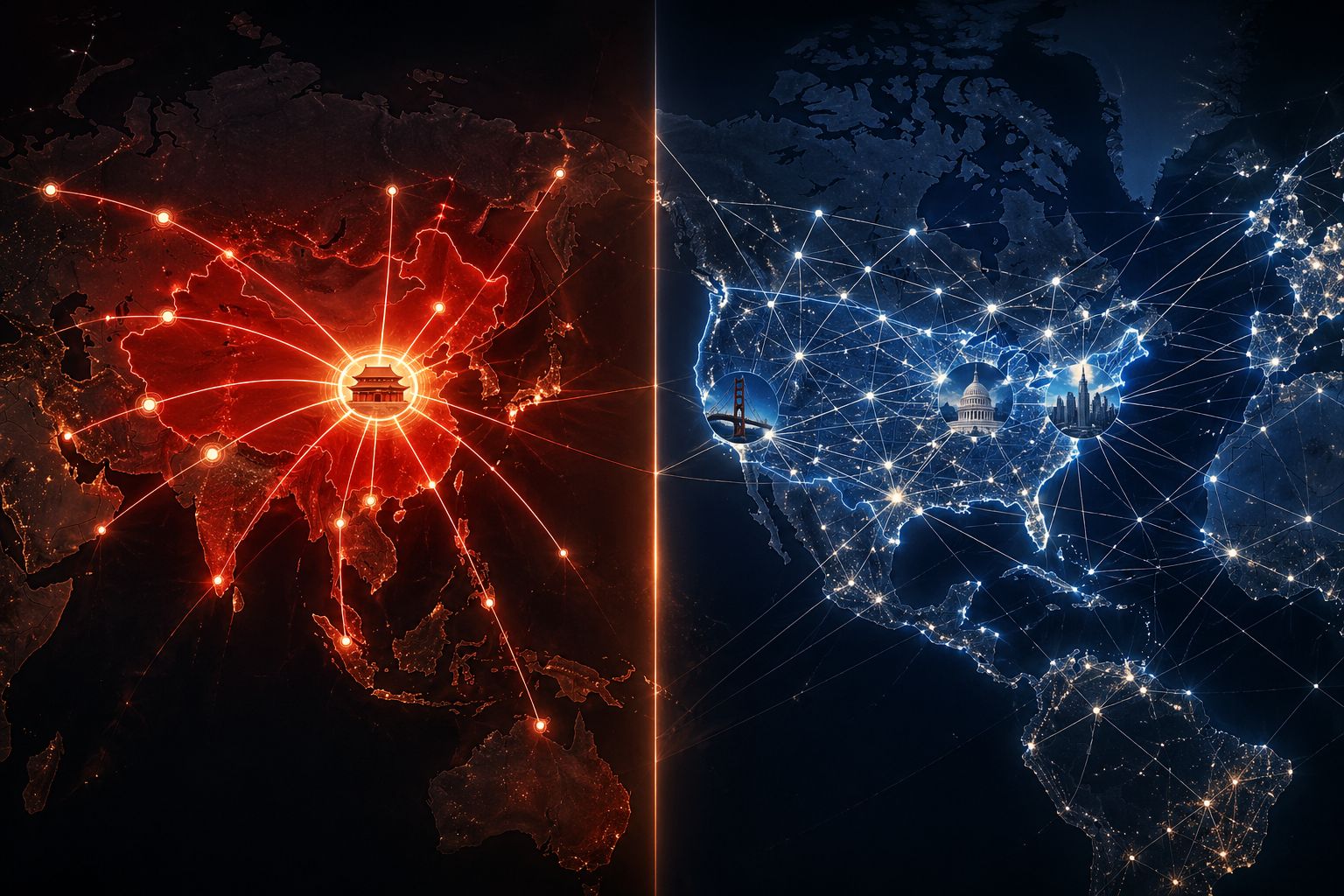
China does not lobby like the West. Instead, it absorbs lobbying into the state. As a result, the boundary between state, corporation, and strategy begins to fade. At the center stands the Chinese Communist Party. It coordinates direction across sectors. Moreover, it enforces alignment when needed.
Importantly, it does not eliminate interest groups. Rather, it disciplines them. At the same time, it integrates them into a shared framework. State-owned firms act as direct instruments. Meanwhile, private giants like Alibaba Group and Tencent operate with conditional autonomy. They grow, yet within limits. They innovate, yet within boundaries.
Therefore, China behaves like one large lobbying entity. Internally, it negotiates. Externally, it acts as one.
However, unity in China is not organic. Instead, it is engineered. On the one hand, regional governments compete for capital. On the other hand, provinces fight for priority. At the same time, Party factions build networks of influence.
Nevertheless, these conflicts do not disappear. Rather, they move behind closed doors. For example, anti-corruption campaigns serve a dual role. First, they remove inefficiency. Second, they remove rivals.
Under Xi Jinping, consolidation increased. Consequently, power centralized. Yet, importantly, this did not eliminate factionalism. Instead, it raised its cost. It reduced its visibility.
Therefore, China compresses conflict. It does not remove it. Instead, it converts competition into controlled rivalry.
The United States as an open arena of competing lobbies
In contrast, the United States functions as an open battlefield. Interest groups compete publicly. Corporations lobby independently. Likewise, financial institutions pursue distinct strategies.
For instance, Wall Street optimizes returns. Meanwhile, Silicon Valley optimizes disruption. Similarly, defense firms optimize threat perception. In parallel, energy firms optimize regulatory advantage.
As a result, these incentives diverge. They rarely align fully. Moreover, elite families also compete. Old capital clashes with new tech wealth. Political dynasties add another layer.
Therefore, the US system generates innovation. However, at the same time, it generates fragmentation.
Elite feuds and the absence of forced alignment
Crucially, American elites do not lack power. Instead, they lack enforced coordination. No central authority compels unity. Consequently, each group follows its own incentives.
For example, financial actors prioritize liquidity. Tech actors prioritize scale. Political actors prioritize elections. Media actors prioritize attention.
As these logics collide, cooperation becomes temporary. Alignment becomes situational. Over time, long-term coherence weakens.
Therefore, the US does not fail from weakness. Rather, it struggles due to internal divergence.
At a deeper level, capital flows define real power. They shape outcomes beneath politics. They determine which sectors rise and which decline.
In China, the People’s Bank of China aligns finance with state goals. Consequently, credit flows into strategic sectors. Infrastructure expands. Manufacturing scales.
By contrast, in the US, the Federal Reserve operates with relative independence. Meanwhile, private capital dominates allocation. Investors chase yield.
As a result, capital moves globally. It leaves weak sectors. It strengthens profitable ones. Therefore, China directs capital strategically. The US allows capital to decide.
The global projection of power through infrastructure
Furthermore, the Belt and Road Initiative acts as systemic lobbying. In this case, China does not only negotiate policy. Instead, it builds structure.
Specifically, ports, railways, and digital networks reshape trade routes. In addition, debt creates leverage. Logistics create dependency.
Over time, countries adjust behavior. Not through direct pressure, but through incentives. Therefore, China influences outcomes indirectly. It redesigns the environment itself.
The fragmented American response and strategic inconsistency
Meanwhile, the US responds across many channels. Diplomacy, trade, sanctions, and alliances all operate. However, they do not fully align.
Moreover, each administration shifts priorities. Internal divisions reshape policy. Institutional fragmentation limits continuity.
As a result, the US reacts. It rarely orchestrates. In other words, it has power, yet often lacks direction.
Financial architecture and systemic asymmetry
At the structural level, China blends planning with markets. It directs development while allowing growth. Capital controls limit instability. State banks channel credit.
Consequently, strategic sectors receive support. Long-term planning dominates. By contrast, the US system emphasizes openness. It prioritizes liquidity.
While this attracts investment, it also creates exposure. Capital exits when returns drop. Industries relocate when costs rise.
Therefore, China stabilizes direction. The US maximizes flexibility.
Industrial policy and technological concentration
Similarly, China targets key sectors deliberately. It invests in AI, semiconductors, and energy. Resources concentrate quickly. Institutions align.
In contrast, the US relies on decentralized innovation. Firms compete. Breakthroughs emerge from rivalry.
Although this creates strong innovation, gaps still appear. Some strategic sectors remain underfunded. Therefore, China accelerates through coordination. The US evolves through competition.
Supply chains as instruments of power
Beyond policy, China dominates critical supply chains. It processes rare earths. It manufactures at scale. It controls key intermediate goods.
As a result, global industries depend on these inputs. Disruptions create leverage. Influence becomes embedded.
Meanwhile, the US offshored production for efficiency. However, dependency increased. Therefore, supply chains now function as strategic tools.
Time horizon asymmetry and strategic patience
Another key factor is time. China operates with long-term horizons. It tolerates delayed returns. It prioritizes positioning over immediate profit.
State-backed lending supports expansion. Currency policy stabilizes exports. Strategic patience shapes decisions.
In contrast, the US operates within shorter cycles. Markets demand quarterly results. Politics follows election timelines.
Therefore, planning compresses. Long-term execution weakens. As a result, time itself becomes a competitive variable.
Information control and narrative alignment
Equally important, China controls information flows. It aligns narratives with policy. It reduces internal contradiction.
Consequently, this supports consistency. It strengthens coordination. Meanwhile, the US allows open discourse. Media compete. Narratives fragment.
As polarization increases, trust declines. Messaging becomes inconsistent. Therefore, China projects unity. The US reflects division.
Intelligence integration versus institutional competition
Likewise, China integrates intelligence across domains. Economic, political, and technological data align. Decision-making centralizes.
By contrast, the US operates through multiple agencies. Private actors also collect data. Overlap increases complexity.
As competition grows within the system, coordination requires effort. Therefore, China gains speed. The US gains diversity.
What the US has never encountered before
At this point, the US faces a hybrid rival. China combines state control with market participation. The Soviet Union lacked this combination.
China uses global capitalism. At the same time, it maintains internal discipline. It aligns capital, policy, and industry.
Therefore, the US faces a structurally new system.
Informal networks and partial alignment in the US
Despite fragmentation, the US is not pure chaos. Informal coordination exists. Elite networks share information and shape agendas.
For instance, institutions like the Council on Foreign Relations and the World Economic Forum facilitate dialogue.
However, they lack enforcement power. Participation remains voluntary. Alignment remains incomplete.
In addition, China uses diaspora networks. Business ties extend influence. Cultural links reinforce alignment.
This pressure remains subtle. It operates indirectly. Meanwhile, the US also has global networks.
However, they act independently. They do not align centrally. Therefore, China integrates external influence more tightly.
Finally, China applies regulation strategically. It loosens control when growth matters. It tightens control when alignment matters.
As a result, adaptability increases. By contrast, the US follows formal legal processes. Regulation remains consistent.
While this protects rights, it slows response. Therefore, China shifts faster. The US adjusts more slowly.
The conspiracy layer: Structure versus exaggeration
Naturally, simple narratives attract attention. China appears as one controlled entity. The US appears chaotic.
However, reality is more complex. Networks exist in both systems. Influence flows through visible and hidden channels.
Although conspiracy theories exaggerate, they still reflect patterns. Therefore, analysis must separate structure from exaggeration.
Conclusion: Coherence versus fragmentation
Ultimately, this rivalry is structural. China prioritizes coherence. It enforces alignment. It channels resources.
Meanwhile, the US prioritizes pluralism. It allows competition. It disperses power.
Each model has strengths. Each has weaknesses. Therefore, the outcome depends on adaptation.
In the end, the key question remains. Which system can evolve faster without breaking?
Leave a Reply