
Revolutions begin with moral outrage. People rise because they believe society has become intolerably unjust. They see corruption, inequality, oligarchic control, repression, poverty, censorship, police brutality, foreign domination, or complete institutional decay. Consequently, revolutionary movements emerge with enormous emotional energy.
At first, revolutions appear morally pure. Crowds gather in streets believing they fight for freedom, justice, equality, dignity, and a better future. Revolutionary leaders often speak the language of morality. They promise honesty instead of corruption, they promise liberty instead of tyranny. They promise fairness instead of exploitation.
However, history repeatedly reveals a brutal paradox. The same revolutions that begin with promises of liberation frequently end with censorship, corruption, authoritarianism, purges, propaganda, oligarchy, and new privileged classes.
The French Revolution ended with terror and eventually Napoleon. The Russian Revolution ended with Stalinist totalitarianism. The Iranian Revolution replaced one authoritarian system with another. Many anti-colonial revolutions produced military dictatorships. Numerous socialist revolutions created party oligarchies. Even revolutions that initially expanded freedom often produced new systems of clientelism and corruption.
Therefore, one must ask a deeper question. Why does this pattern repeat so consistently across different cultures, religions, ideologies, and historical periods?
The answer does not lie in a single ideology. Rather, it emerges from the interaction between human evolution, power structures, institutional collapse, tribal psychology, economic instability, violence, and the biological realities of Homo sapiens. Ideologies are products of human evolution and they served to our ancestors somehow.
Human evolution never prepared us for modern revolutions
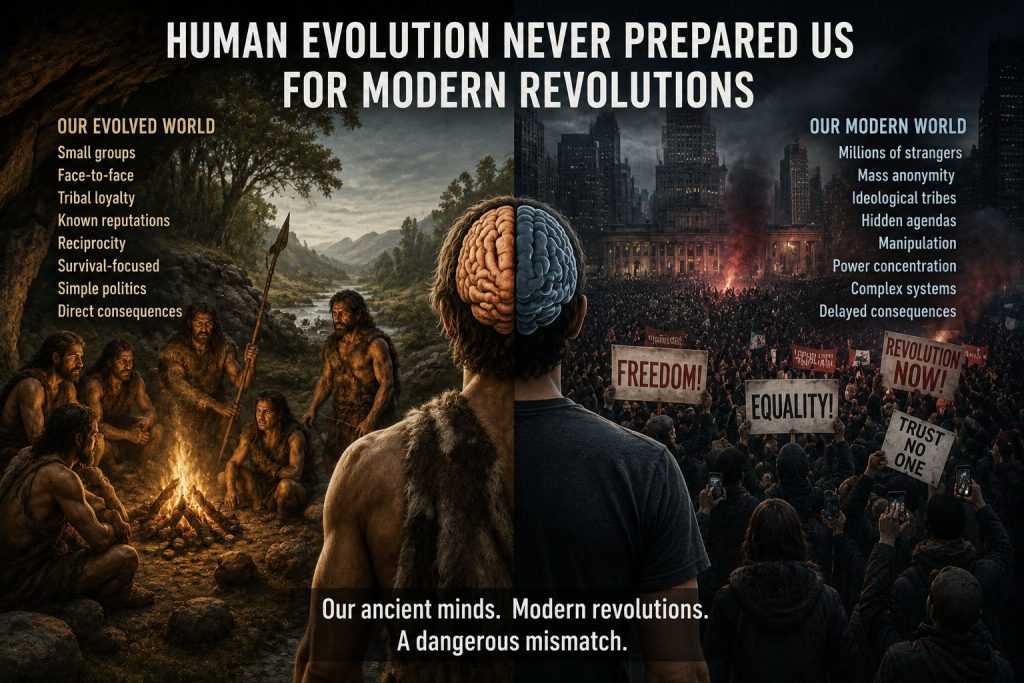
Humans evolved in small hunter-gatherer groups, not in industrial nation-states with millions of strangers. For hundreds of thousands of years, people lived in tribes where social relationships remained personal, direct, and emotionally immediate.
In those environments, survival depended on coalition-building, tribal loyalty, status competition, reciprocal favors, dominance hierarchies, reputation management, and protection against rival groups. Consequently, human psychology evolved around small-group politics rather than universal principles.
Modern revolutions activate these ancient instincts on a massive scale.
At first glance, revolutionary slogans sound ideological. However, beneath the ideology often lies tribal psychology. Revolutionaries divide society into moral tribes. The pure versus the corrupt. The oppressed versus the oppressors. The people versus the elite. Patriots versus traitors. Believers versus enemies.
This division simplifies reality emotionally. Therefore, it becomes extremely powerful psychologically.
Moreover, revolutionary movements create strong collective identity. Individuals suddenly feel part of something larger than themselves. Shared outrage creates emotional unity. Crowds amplify emotions further. As a result, revolutionary identity can become stronger than individual reasoning.
Once revolutionaries seize power, the same evolutionary instincts continue operating. Leaders reward loyal allies. Rivals become threats. Nepotism appears naturally because humans trust family and close associates more than strangers. Coalition-building becomes essential for political survival.
Consequently, corruption does not emerge merely because people “betray ideals.” Instead, corruption emerges because human beings remain biological organisms shaped by evolutionary pressures that reward self-preservation, tribal loyalty, status accumulation, and coalition protection.
Power fundamentally changes human behavior
Power alters psychology profoundly. Even individuals who begin with sincere intentions often change once they gain authority.
At the beginning of revolutions, leaders usually present themselves as servants of the people. However, once they gain power, their environment changes completely. They receive constant praise. Supporters treat them as historic figures. Critics become enemies. Loyalists protect them from negative information. Gradually, they become psychologically isolated.
This isolation produces dangerous effects.
First, leaders begin believing they personally embody the revolution. Therefore, criticism against them becomes interpreted as criticism against the movement itself.
Second, fear intensifies. Revolutionary systems are unstable. Leaders know rivals want power. They fear coups, betrayals, assassination attempts, foreign intervention, and internal dissent. Consequently, paranoia grows.
Third, loyalty becomes more important than competence. Leaders prefer obedient allies rather than independent thinkers. As a result, institutions become filled with loyalists instead of qualified individuals.
Over time, the revolution stops focusing on justice and starts focusing on regime survival.
This transition appears repeatedly throughout history. Revolutionary governments increasingly justify censorship, repression, surveillance, and corruption as necessary defensive measures. Every failure gets blamed on sabotage, conspiracies, foreign agents, or traitors.
Thus, power slowly transforms moral idealism into self-preservation.
Revolutions destroy institutions faster than they create them
Stable institutions require enormous time to develop. Courts, administrative systems, professional bureaucracies, constitutional norms, property rights, law enforcement structures, and economic coordination mechanisms often emerge over centuries.
Revolutions frequently destroy these structures rapidly.
At first, dismantling institutions may feel liberating because old institutions often appear corrupt or oppressive. However, destroying institutions creates enormous power vacuums.
When courts collapse, informal power replaces legal authority; when police structures weaken, armed factions emerge; when economic systems disintegrate, black markets dominate. When bureaucracies disappear, personal networks replace administrative procedures.
Consequently, revolutions unintentionally reward ruthless personalities. Opportunists thrive during chaos. Criminal groups adapt quickly. Warlords gain influence. Ideological extremists organize aggressively. Meanwhile, moderate individuals often struggle inside unstable systems.
The French Revolution demonstrated this clearly. Revolutionary institutions repeatedly collapsed into instability, factional struggles, and terror. Similarly, the Russian Revolution destroyed old state structures but lacked functioning replacements. The result became civil war, authoritarian centralization, and massive coercion.
Therefore, revolutions often eliminate corrupt systems only to create conditions where corruption expands even further.
The illusion of revolutionary purity
Revolutionary movements often believe they represent absolute morality. This belief becomes extremely dangerous.
Once a movement views itself as morally perfect, disagreement becomes interpreted as betrayal rather than legitimate criticism. Consequently, revolutionary systems develop ideological rigidity.
Moderates become suspicious. Independent thinkers appear dangerous. Nuance disappears. Complex problems become simplified into moral binaries.
Moreover, revolutionary movements frequently compete internally over purity. Different factions accuse one another of insufficient commitment. Radical groups attempt to outbid one another ideologically. Therefore, extremism escalates naturally.
The French Revolution illustrates this process dramatically. Moderates initially supported constitutional reform. However, radical factions gradually gained influence. Eventually, revolutionary leaders themselves became targets. The revolution entered the Reign of Terror, where executions multiplied rapidly in the name of protecting revolutionary virtue.
The Russian Revolution followed a similar pattern. Bolsheviks justified repression as necessary for defending socialism. Later, Stalin expanded this logic into massive purges, show trials, forced confessions, executions, and labor camps.
Thus, revolutions frequently consume their own creators because ideological purity becomes impossible to satisfy.
Corruption becomes a survival mechanism
In stable societies, institutions partially regulate human behavior. Courts, contracts, predictable laws, and functioning bureaucracies reduce uncertainty.
Revolutionary societies often destroy this predictability.
Under unstable conditions, people rely increasingly on informal networks. Family members help relatives. Party members help loyalists. Friends exchange favors. Bribery accelerates access to scarce resources. Tribal identity becomes politically valuable.
Consequently, corruption evolves into a survival strategy.
Individuals who refuse to participate may become disadvantaged economically or politically. Without connections, they struggle to obtain jobs, protection, licenses, housing, medicine, or opportunities.
Thus, corruption gradually stops appearing abnormal. Instead, it becomes the practical operating system of society.
This phenomenon appeared repeatedly in revolutionary states. Soviet systems developed extensive informal economies. Party connections became essential for advancement. Similar patterns emerged in numerous post-colonial states where formal institutions remained weak.
Therefore, corruption often expands because revolutionary instability destroys institutional trust itself.
Revolutions rarely eliminate elites
Many revolutions promise equality. However, revolutions rarely abolish hierarchy completely. Instead, they replace one elite with another.
Aristocrats become party officials. Monarchies become revolutionary committees. Religious authorities become ideological bureaucracies. Wealthy oligarchs become military-industrial insiders. Old privileged families get replaced by politically connected families.
The structure changes. The hierarchy remains.
Human societies naturally generate status hierarchies because individuals differ in intelligence, ambition, charisma, aggression, organizational ability, and social influence. Consequently, concentrated power tends to reappear even after revolutionary upheaval.
Moreover, revolutionary leaders often justify their privileges as necessary sacrifices for the movement. Luxury becomes rationalized. Political favoritism becomes defended as revolutionary necessity.
Over time, revolutionary elites begin resembling the very classes they once condemned.
This paradox deeply frustrated many citizens inside communist systems. Official ideology promised equality. Nevertheless, party elites enjoyed privileged housing, better healthcare, special stores, superior education, and political immunity.
Thus, revolutions frequently fail not because hierarchy disappears, but because hierarchy merely changes costume.
Violence reshapes morality
Most revolutions involve violence. Even initially peaceful revolutions often radicalize under pressure.
Violence fundamentally changes social psychology.
Once killing becomes normalized politically, moral boundaries weaken. Individuals adapt psychologically to brutality. Revolutionary systems justify violence as historically necessary. Consequently, cruelty gradually becomes institutionalized.
Moreover, violent environments reward certain personality traits. Ruthless individuals often rise faster during unstable conditions because they tolerate coercion, intimidation, and brutality more effectively than ethical or cautious individuals.
This selection effect matters enormously.
Revolutions frequently elevate people skilled at conflict rather than governance. Military figures, propagandists, radical ideologues, and ruthless organizers gain influence quickly. However, these traits rarely produce transparent, accountable institutions.
Violence also destroys social trust. Citizens become afraid of speaking honestly. Informants appear everywhere. Suspicion spreads. Therefore, corruption expands more easily because fear prevents accountability.
Historical revolutionary systems repeatedly demonstrated this process. Secret police structures, purges, forced confessions, labor camps, disappearances, and censorship emerged not accidentally, but through systems already conditioned by violence.
Economic collapse fuels corruption
Revolutions often damage economic stability severely.
Production declines. Investment disappears. Skilled professionals flee. Currency instability emerges. Supply chains collapse. Food shortages increase. Inflation accelerates.
Under these conditions, access to resources becomes politically valuable.
Officials controlling permits, transportation, food distribution, housing, or imports suddenly gain enormous power. Consequently, bribery expands rapidly.
Black markets emerge because official systems cannot satisfy demand. Informal economies replace regulated markets. Smuggling networks develop. Organized crime grows stronger.
This pattern appeared repeatedly throughout revolutionary history. Revolutionary France faced inflation and shortages. Soviet systems developed extensive underground economies. Venezuela experienced massive black-market expansion during economic collapse. Numerous post-colonial revolutions produced similar outcomes.
Therefore, corruption often emerges structurally from economic instability itself.
Revolutionary leaders often understand destruction better than governance
Overthrowing a system requires different skills than running one.
Revolutionary movements usually excel at mobilizing outrage, simplifying narratives, attacking legitimacy, organizing protests, and destabilizing authority. However, governing modern societies requires administrative competence, technical expertise, long-term planning, institutional continuity, economic coordination, and complex management systems.
Many revolutionaries underestimate this reality.
Once in power, they confront immense practical challenges:
- food distribution
- infrastructure maintenance
- industrial production
- energy systems
- healthcare
- education
- foreign relations
- fiscal management
- law enforcement
If revolutionary governments lack competence, disorder expands rapidly. In response, leaders often centralize power further to maintain control. Consequently, authoritarianism grows alongside incompetence.
Corruption then flourishes because unstable systems create opportunities for manipulation, favoritism, and informal influence.
Foreign powers manipulate revolutions
Revolutions rarely remain purely domestic phenomena.
Foreign governments, intelligence agencies, multinational corporations, financial institutions, ideological networks, and geopolitical rivals often intervene actively.
They fund factions., they spread propaganda, they provide weapons. And they influence media narratives. They manipulate economic pressure. They support favorable elites.
Consequently, revolutionary systems frequently become entangled with international power struggles.
The Cold War demonstrated this repeatedly. Both the United States and the Soviet Union supported coups, insurgencies, dictatorships, and revolutionary movements worldwide. Foreign involvement often intensified corruption because external actors rewarded loyalty rather than institutional integrity.
Moreover, revolutionary governments sometimes justify internal repression by citing foreign threats. In many cases, these threats are partly real. However, they also become convenient tools for consolidating power.
Thus, international intervention frequently deepens revolutionary corruption rather than reducing it.
Propaganda protects corruption
Every revolutionary regime constructs mythology.
Leaders become heroic symbols. Revolutionary narratives simplify history. Official propaganda glorifies sacrifice and demonizes opponents.
At first, propaganda helps unify society emotionally. However, over time, it protects corruption from scrutiny.
Failures become blamed on enemies. Economic collapse becomes sabotage. Criticism becomes treason. Journalists become agents. Opposition becomes conspiracy.
Therefore, accountability weakens dramatically.
Once leaders become sacred figures, corruption expands unchecked because criticism itself appears illegitimate.
This phenomenon occurred across ideological systems:
- communist cults of personality
- fascist propaganda states
- theocratic revolutionary narratives
- nationalist revolutionary myths
Different ideologies produced similar mechanisms because the psychological structure remained comparable.
The Czech case and Václav Havel
The Czech experience after 1989 illustrates another uncomfortable reality about revolutions and systemic change. Removing one system does not automatically create justice, transparency, or rational governance. In many cases, old structures simply transform themselves into new forms.
The Velvet Revolution appeared exceptionally peaceful compared to many historical revolutions. There were no massive purges, no civil war, and no revolutionary terror comparable to France, Russia, China, or Iran. Consequently, many people viewed the Czech transition as proof that society could move smoothly from authoritarianism toward democracy and capitalism.
However, deeper structural problems remained.
First, overthrowing communism did not suddenly create a politically educated population capable of controlling complex modern capitalism. Political slogans changed rapidly, but economic power structures became far more difficult to understand.
Raw power
Under communism, power concentrated visibly inside the party-state. Under capitalism, power dispersed through corporations, privatization networks, banks, investment groups, lobbying systems, multinational influence, media ownership, and international financial structures. Therefore, political influence became less visible rather than disappearing.
This distinction matters enormously.
Many citizens imagine corruption as a simple phenomenon involving envelopes full of money or obvious bribery. However, modern influence often operates legally through lobbying, privatization deals, financial dependency, media narratives, personal networks, consulting structures, and revolving doors between politics and business.
Consequently, populations without deep political, economic, and institutional literacy struggle to monitor modern systems effectively.
Poor voting culture
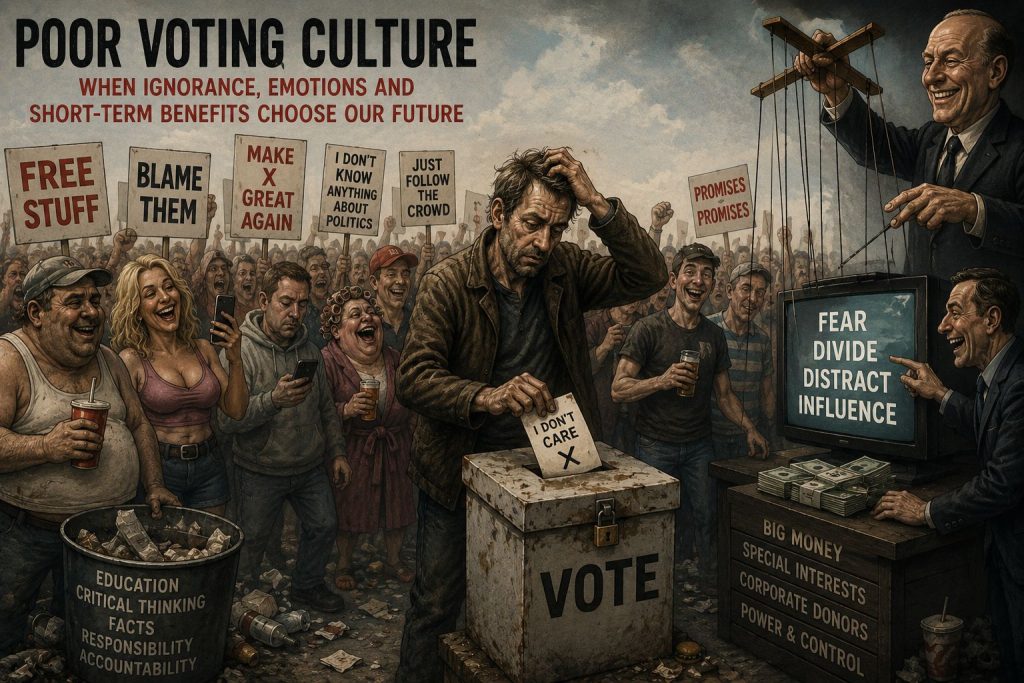
This problem does not apply only to the Czech Republic. Even highly educated Western populations often fail to understand how modern power structures operate. Nevertheless, countries like Switzerland or Germany historically developed stronger institutional cultures, administrative continuity, industrial organization, and civic discipline over long periods. Their systems still contain lobbying, elite influence, and corruption pressures. However, institutional traditions partially stabilize them.
Post-communist societies often lacked these stabilizing traditions because communist systems weakened independent institutions, civil society, entrepreneurial continuity, and decentralized political culture for decades.
Therefore, revolutionary anger inside such environments can become extremely dangerous.
If citizens cannot realistically control politicians, understand economic systems, distinguish propaganda from analysis, or maintain institutional stability, another revolution may produce outcomes far worse than the injustice people originally opposed.
Václav Havel
History repeatedly demonstrates this paradox. Societies overthrow one corrupt system only to create another system even less transparent and more unstable.
This tension also appeared in the reflections of Václav Havel himself.
Although many people later portrayed Havel as a symbolic representative of triumphant liberal capitalism, his own views remained far more complicated. Havel repeatedly expressed skepticism toward both unchecked consumerism and simplistic economic triumphalism.
Moreover, Havel reportedly acknowledged that he held no naive illusions about global power politics back in communism. He understood that American foreign policy did not operate purely through abstract morality or human rights rhetoric. Instead, geopolitical interests, economic interests, corporate pressures, strategic calculations, and private influence networks played major roles inside international politics.
But then he was cuddling with George W. Bush and supported Iraq War.
So naive?
This observation was not unique to Havel. Many political realists across ideological spectrums recognized similar dynamics. Great powers rarely operate exclusively through moral principles. They also operate through strategic interests, economic competition, alliances, energy security, military influence, and domestic lobbying pressures.
At the same time, Havel reportedly never imagined the post-communist transition as a simple embrace of ruthless capitalism without social protections. Like many dissidents from Eastern Europe, he criticized bureaucratic authoritarianism, censorship, and state repression. However, this did not automatically mean support for every aspect of neoliberal economic transformation.
The transition created profound social shocks:
- privatization controversies
- economic inequality
- corruption networks
- oligarchic influence
- unemployment
- social insecurity
- rapid wealth concentration
For populations raised under systems promising full employment and social guarantees, these transformations felt psychologically destabilizing.
This issue remains deeply important because classical economic theory itself acknowledges that unemployment is structurally embedded within capitalist systems to varying degrees. Labor markets fluctuate. Businesses fail. Competition creates winners and losers. Automation displaces workers. Economic cycles generate instability.
Therefore, the post-1989 expectation that capitalism would automatically deliver prosperity without major social disruption proved unrealistic.
Many post-communist citizens gradually discovered that replacing one system with another did not eliminate human incentives, elite networks, opportunism, corruption, or power concentration. Instead, these forces merely adapted to a different environment.
Consequently, the Czech experience demonstrates a broader lesson about revolutions themselves. Improving political climate other ways than revolution may bring real changes.
People often imagine political transformation as a moral reset. However, societies do not restart from zero. Historical habits, institutional weaknesses, economic realities, psychological instincts, and power structures continue operating beneath new ideological language.
Thus, a society unable to maintain institutional accountability after one revolution may produce even deeper injustice after the next one.
Modern technology transformed revolutionary dynamics further.
Social media accelerates outrage, emotional contagion, tribal polarization, and misinformation. Algorithms reward emotional intensity rather than accuracy. Simplified narratives spread faster than complex analysis.
Consequently, modern revolutionary movements can escalate extremely rapidly.
Moreover, digital environments create permanent emotional mobilization. Outrage never fully disappears. Every political issue becomes amplified continuously. Therefore, societies remain psychologically destabilized for long periods.
At the same time, intelligence agencies, corporations, political actors, bots, influencers, and ideological groups increasingly manipulate online discourse strategically.
Thus, modern revolutions may become even more vulnerable to psychological manipulation than historical ones.
The deeper problem may be human nature itself
Many people believe corruption results purely from bad ideology. However, history suggests a deeper problem.
Monarchist revolutions, communist revolutions, nationalist revolutions, religious revolutions, anti-colonial revolutions, and democratic revolutions often reproduce surprisingly similar patterns:
- concentration of power
- propaganda
- tribalism
- corruption
- new elites
- repression
- ideological rigidity
- self-preservation
Therefore, the recurring issue may not simply be capitalism, socialism, religion, nationalism, or monarchy individually.
Instead, the recurring issue may be concentrated power operating through evolved human psychology.
Humans seek status, humans protect tribes, humans rationalize self-interest morally. And humans fear uncertainty; humans reward loyalty. Humans imitate groups. Humans simplify complexity emotionally.
Revolutions do not erase these instincts. In many cases, they intensify them.
Can revolutions avoid corruption?
No system can eliminate corruption completely because no system can eliminate human incentives entirely.
However, some structures reduce the probability of revolutionary collapse:
- strong institutions
- separation of powers
- decentralized authority
- transparent governance
- independent courts
- free media
- gradual reform
- stable constitutional systems
- institutional accountability
- peaceful transfers of power
Gradual reform often succeeds more sustainably than violent revolutionary destruction because it preserves institutional continuity while allowing adaptation.
Nevertheless, even democracies remain vulnerable. Polarization, populism, tribal media ecosystems, oligarchic influence, and institutional decay can slowly produce revolutionary conditions internally.
Therefore, the danger never disappears completely.
Conclusion
Revolutions begin with hope. They begin with moral outrage against injustice, corruption, inequality, or oppression. Millions of people throughout history genuinely believed they were building a better world.
However, revolutions repeatedly encounter the same biological and structural realities.
Human beings evolved for tribal survival, not for managing enormous modern states rationally. Power alters psychology. Violence normalizes brutality. Institutional collapse rewards opportunists. Economic instability fuels corruption. Propaganda protects elites. Fear destroys accountability.
Consequently, revolutions often recreate the very systems they originally sought to destroy.
The flags change. The slogans change. The uniforms change. Yet the deeper mechanisms frequently remain astonishingly similar.
Thus, the greatest lesson of revolutionary history may not concern ideology alone. Instead, it may reveal something profoundly uncomfortable about human nature itself.
Leave a Reply